
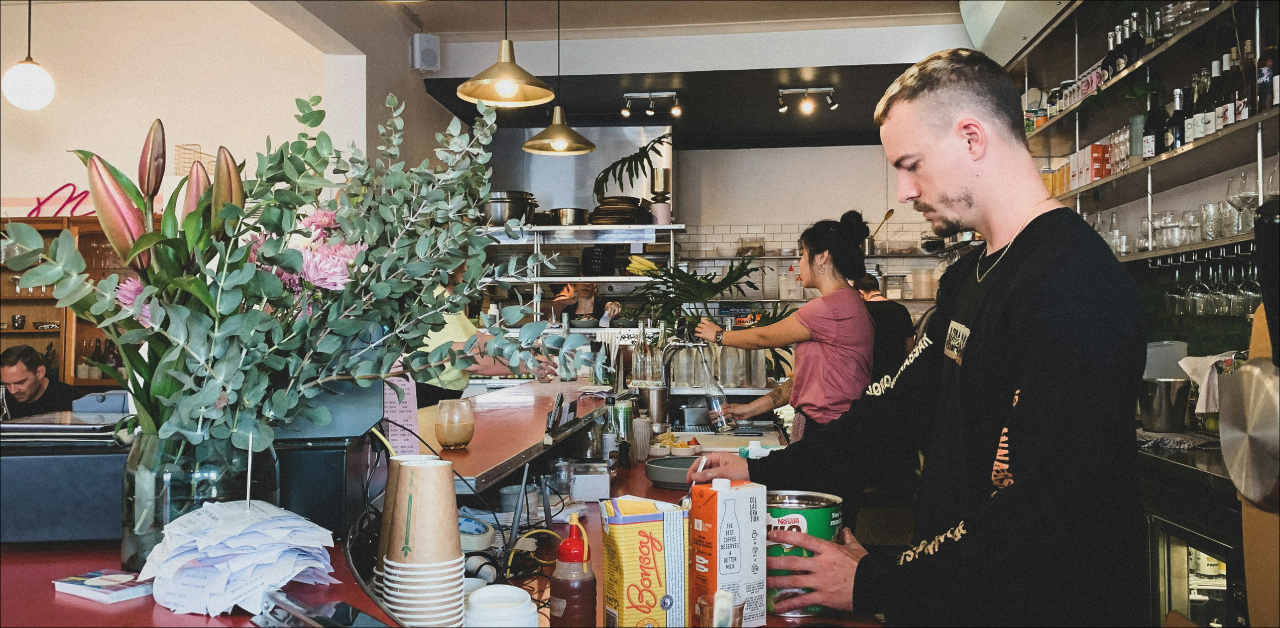
Australian coffee culture is not an accident, and it is not a trend. It is the result of decades of migration, craft, and daily ritual, brewed slowly into something the rest of the world now imitates. Walk into any independent café in Melbourne or Sydney, order a flat white, and you are stepping into one of the most refined coffee traditions on the planet.
We say that plainly, and the evidence backs it up. Australians drink around 2.7 cups of coffee a day. Yet volume is not the point. What sets this country apart is the standard. A good coffee here is expected, not celebrated. That expectation is the quiet engine behind everything that follows.
At LUNGO, coffee sits at the centre of what we do. So it makes sense to start at the source: the culture itself.
What Makes Australian Coffee Culture Different?
Australian coffee culture is different because it is built on independence, not scale. Roughly 95% of the country's coffee shops are independent, small businesses run by people who care about the cup. There is no dominant chain shaping the national taste. Instead, thousands of local baristas do.
This changes everything. When your neighbourhood café competes on quality rather than convenience, the whole standard rises. The barista knows your order. The beans are often roasted locally. The espresso is dialled in daily. Consequently, mediocre coffee simply does not survive here.
Compare that to markets where speed and sweetness win. In Australia, the drink itself is the product. Not the syrup. Not the branding. The coffee.
This standard travels well beyond Melbourne, too. Sydney's inner suburbs run on the same espresso discipline. Perth and Fremantle have quietly built one of the country's most exciting café scenes. Even a small regional town will often surprise you with a serious cup. In other words, Australian coffee culture is national, not niche.
A Culture Built by Migrants
To understand Australian coffee culture, you have to look back to the years after the Second World War. Between 1945 and 1975, roughly 360,000 Italian immigrants arrived, alongside Greek and other European communities. They brought espresso machines, technique, and a deep belief that a café is a social space, not a service counter.
In Melbourne, this energy gathered around Carlton and Lygon Street. Pellegrini's Espresso Bar opened in 1954. Legend Café followed in 1956. These rooms did more than serve coffee. They rebuilt a way of living around it.
That inheritance still shapes the modern café. The espresso bar model, the ritual of standing for a quick shot, the idea that coffee is culture rather than fuel, all of it traces back to those first migrant rooms. Australian coffee culture, in other words, was imported with love and then made its own.

The Flat White and the Language of Australian Coffee
No drink captures Australian coffee culture better than the flat white. It emerged in Australia and New Zealand during the 1980s. Café owner Alan Preston claims he added it to the menu at Sydney's Moors Espresso Bar in 1985, though the exact origin is warmly contested on both sides of the Tasman.
The flat white is deceptively simple. Espresso, steamed milk, a thin layer of microfoam. No excess. It rewards precision, which is exactly why it became a national signature.
The rest of the menu speaks its own dialect. Australians order lattes (around 33% of coffee sold), flat whites (29%), and cappuccinos (18%). The long black stands apart as a local favourite, and it is easily confused with the lungo. If you have ever wondered how they differ, that difference is a story of its own.
Why Starbucks Couldn't Crack Australia
The clearest proof of Australian coffee culture's strength is what happened when Starbucks arrived. The chain entered in 2000 and expanded fast, reaching 87 stores by 2008. Then it collapsed. Starbucks closed roughly two-thirds of its Australian locations and reportedly lost around 105 million US dollars over its first seven years.
Why? Because it misread the room. Starbucks sold convenience and sugar to a country that already had espresso and standards. Australians did not need a global brand to tell them what good coffee was. They already trusted the barista down the road, and that coffee usually cost less.
The lesson is simple. You cannot import a coffee culture into a country that already built a better one. Interestingly, Starbucks later found a smaller, steadier footing by adapting to tourists and city centres rather than trying to convert locals. The message held: in Australia, the barista wins.
Melbourne: The Coffee Capital
Any honest account of Australian coffee culture arrives, eventually, in Melbourne. The city is often called the coffee capital of the world, and it has the café density to defend the title. Fitzroy, Carlton, and Collingwood alone hold more serious coffee than many entire countries.
Melbourne treats coffee the way Kyoto treats tea and the way Copenhagen treats design. It is a discipline. There is a reason the city's café scene reshaped how the world drinks coffee, and it deserves a closer look.

The Ritual Behind the Cup
Strip away the statistics and Australian coffee culture is really about ritual. The morning walk to the café. The barista's nod. The pause before the day begins. Coffee here marks a moment of intention in the rhythm of modern life.
This is where design and coffee meet. A good ritual is made of good objects and good spaces. The cup, the room, the light, the pace. Each element is chosen, not accidental. That is the same principle that guides everything we make at LUNGO: intention over excess, craft over noise.
There is a wider lesson here, and it echoes across other disciplines. Japanese tea ceremonies treat a single cup as a complete event. Scandinavian design proves that restraint can feel warm rather than cold. Australian coffee culture belongs in that same conversation. It shows that an everyday habit, done with care, becomes a form of quiet craft. Nothing is rushed. Nothing is wasted. The ordinary is elevated simply by paying attention to it.
Sustainability follows naturally from that mindset. When you value the cup, you start to value what happens to it after the last sip.
What Happens After the Last Sip?
Here is the part of Australian coffee culture we rarely see. Every one of those millions of daily cups leaves something behind: spent coffee grounds. Across the country, more than 90% of used coffee grounds are sent to landfill, where they release methane, a greenhouse gas far more potent than carbon dioxide. Melbourne social enterprise Reground has been working to change that, diverting thousands of tonnes of grounds away from landfill, café by café.
This is exactly where LUNGO begins. We see coffee not only as a drink, but as a material. Spent grounds can become eyewear, textiles, bags, and objects designed to last. The residue of the ritual becomes the beginning of something new.
Design first. Coffee always. Sustainability naturally. That order matters. We do not start with a lecture about waste. We start with better objects, made from a material the world already produces in abundance.
Australian coffee culture taught a nation to expect more from a cup. LUNGO simply asks the next question: what if we expected more from what the cup leaves behind?
Australian Coffee Culture: Quick Questions
Why is Australian coffee culture considered the best?
Australian coffee culture is considered among the best because it is built on independent cafés, locally roasted beans, and highly trained baristas. With around 95% of coffee shops independent, quality is set by thousands of small businesses competing on craft rather than a single dominant chain.
Where did the flat white come from?
The flat white emerged in Australia and New Zealand in the 1980s. One widely cited claim credits café owner Alan Preston, who put it on the menu at Sydney's Moors Espresso Bar in 1985. Its precise origin remains a friendly rivalry between the two countries.
Why did Starbucks fail in Australia?
Starbucks failed in Australia because it sold convenience and sweet drinks to a market that already valued espresso and social café culture. After expanding to 87 stores by 2008, it closed about two-thirds of them, having lost an estimated 105 million US dollars in seven years.
What makes Melbourne the coffee capital?
Melbourne is called the coffee capital of the world thanks to its extraordinary café density and its deep espresso heritage, rooted in post-war Italian migration to suburbs like Carlton. The city treats coffee as a craft, and its scene has influenced how coffee is served globally.